Tell us about yourself in a paragraph or two: What is your name, and what are you studying? Where are you from? What was your dream job as a kid? What’s your favourite thing to do outside of school/work?
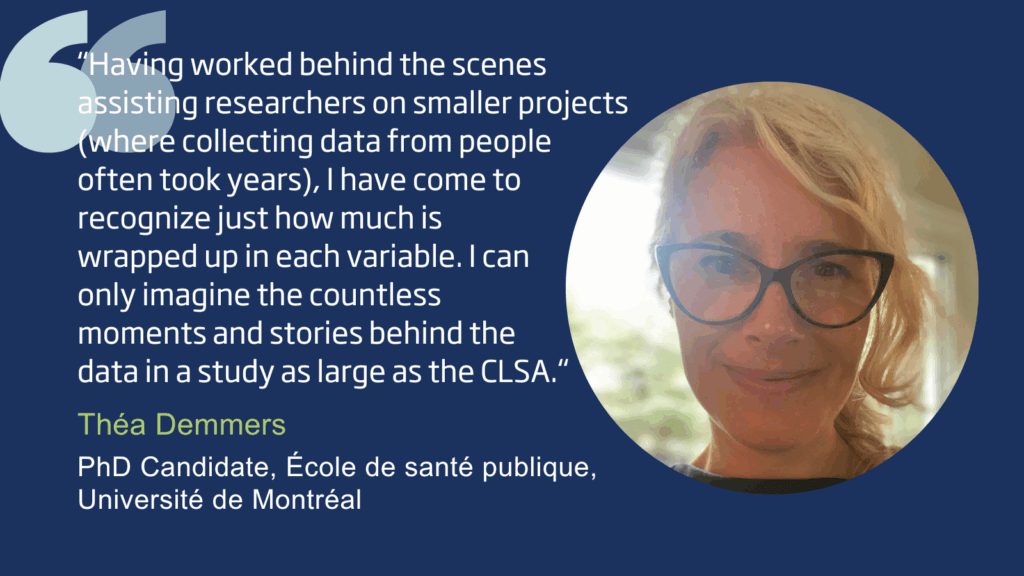
My name is Théa Demmers, and I am a dietitian-nutritionist with degrees from Messiah University and McGill University. Since 2004, I have had the privilege of working on food security projects and supporting individuals—mothers, teens, adults and athletes—through nutrition counseling and workshops (often involving hands-on cooking!). I have partnered with a range of various community organizations and served as a research professional and instructor at Concordia University.
I grew up on a farm on Scugog Island in Ontario, where we grew vegetables without pesticides and raised a few cows. Since 2002, though, Montreal has been home. What really influenced my decision to become a dietitian was when my younger sister was diagnosed with type 1 diabetes at 16 years old. A dietitian came to our home to help her learn how to manage living with type 1 diabetes. The whole experience deeply impacted our family and set me on a path to pursue nutrition and dietetics and eventually become a registered dietitian.
I enjoy tending to a small garden, though I prefer growing flowers, onions and hot peppers, as they attract less loopers! As a kid, I cleaned so many loopers from vegetables that I would see them when my eyes closed. I also like taking walks with my dog and husband and spending time with my sons.
What interested you about the CLSA?
Working with CLSA data was a perfect opportunity to explore relationships between malnutrition among older adults and arthritis, using a large, representative Canadian sample. I had the opportunity to work as a research professional at Concordia University’s PERFORM Centre from 2012 to 2022, where I collaborated with Dr. Lisa Kakinami. We developed an ongoing partnership with McGill University, working with Hugues Plourde to create opportunities for dietetics students. We also collaborated with a dietitian specializing in arthritis, Kim Arrey, a researcher specializing in aging, Guylaine Ferland and Beth Armour, a dietitian instrumental for the Practice-based Evidence in Nutrition (PEN) tool, for knowledge translation to dietitians.
What type of research are you doing with CLSA data? Have you published? If so, what are the findings (in lay terms)?
Currently, we are examining the relationship between malnutrition, arthritis and levels of disability associated with arthritis, in terms of activities of daily living (e.g. eating), and instrumental activities of daily living, (e.g. meal preparation). We published this work in Scientific Reports in 2024.
There are known risk factors for malnutrition, such as recent weight changes, skipping meals, loss of appetite, difficulty swallowing, eating less fruit and vegetables, drinking fewer fluids and eating alone most of the time. These can be measured and scored for ‘nutrition risk’.
We found that people living with arthritis had poorer nutrition risk scores than people without arthritis. These scores were even worse when arthritis was combined with difficulty performing daily activities like eating or grocery shopping. You might assume that the challenges with daily activities lead to higher nutrition risk, such as eating less or experiencing weight loss. But our findings showed that even after adjusting for these functional difficulties, the link between arthritis and nutrition risk remained. This suggests that while functional impairment plays a role, it doesn’t fully explain the increased risk. There are other factors, unique to each type of arthritis—such as which joints are affected and how this impacts daily activities—that need to be studied more for their impact on nutrition risk.
Our findings highlight the need for healthcare professionals to consider referring individuals with arthritis for nutrition support.
What is the most interesting or surprising thing you’ve learned from your work with the CLSA? How do you think the CLSA will help you grow as a student or in your future?
One of the most interesting things I have learned from working with the CLSA is that nutrition risk in older adults is often not just about food availability, but also about social factors like living alone, limited social support, or reduced participation in community life. These social determinants emerged as powerful predictors of whether older adults were at risk of poor nutrition, shifting our understanding of nutrition from being solely an individual or medical issue to a social one as well.
How do you think the CLSA will help you grow as a student or in your future?
I worked on this project both as a research professional at Concordia University and as a doctoral student in public health. I learned how to access data and critically evaluate the variables required. The CLSA is such a large platform, reflecting so many people’s hard work. Having worked behind the scenes assisting researchers on smaller projects (where collecting data from people often took years), I have come to recognize just how much is wrapped up in each variable. I can only imagine the countless moments and stories behind the data in a study as large as the CLSA.
Working on this project with Dr. Kakinami strengthened my appreciation for the potential of data sharing and for the commitment of the participants, researchers, and other professionals involved. I believe my experience with the CLSA will continue to shape my growth, and I am especially interested in future opportunities to work with its longitudinal data.
How do you think the findings using CLSA data will be useful to you, or others, in the future?
Many relationships between determinants of health and the aging process take years to develop, so it will be exciting to see what future analyses of the longitudinal data will reveal.
Do you have any idea about what kind of job you’d like to do when you finish school?
Ongoing research in the community, along with teaching and continued learning.
What is a non-career related thing that you are grateful for because of your work with the CLSA?
I hope my work will lead to greater support for people living with arthritis, especially when it comes to accessing, preparing, and enjoying food.