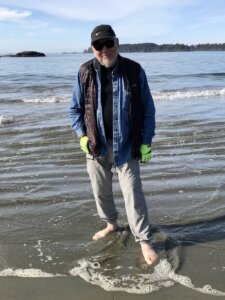
After working in both the special education system and government, Allan, 78, found that his true passion in life is to help others. An avid traveller, Allan has journeyed from his home town of Winnipeg, through his career working in Ottawa, and has visited England, France and Australia. He advises to not be afraid to ask for help, and to focus on the things that mean the most to you. Aging is a challenge, but it’s possible to work around these things!
 Can you tell us a little bit about yourself?
I grew up in Winnipeg and was in the gifted program in elementary and secondary school. After graduating, I got a job with the Federal government in Ottawa, where I met my wife in 1967. After working with the government, I fell in love with elementary and secondary school teaching, but more specifically I worked with students in special education. Towards the end of my career in education I was starting to feel burnt out, but I continued to follow my passion for helping people. Since my wife and I had no children, we had the freedom to travel after I retired at 52.
In 2010, I was diagnosed with Multiple Sclerosis (MS) and have since been actively involved in MS Canada, where my team “Miller’s Milers” has recently ranked for raising more than $100,000 over the last few years. The team for MS Canada is something that is absolutely worth doing for me, and I take about 3 months out of the year to send personalized emails to help raise money for MS research.
How long have you been a participant with the CLSA?
I started about 10 to 15 years ago, when I was living in Ottawa.
What does healthy aging mean to you? What is your current approach to aging healthily?
Healthy aging to me involves action and inaction; circumstances influence how you age, and you are either lucky or not so lucky. Life experiences—no matter what part of your life—will also have an impact on how you age. It’s important to focus on what you can do as an individual, like managing your money.
It also important to stay socially connected. My wife and I both regularly go to a local senior centre to stay active but also to visit with friends, attend ballet and group dance performances. We love the symphony and have a theatre not too far from where we live, so we often walk over to see whatever is playing! Through my experiences as a teacher, I learned to be more extroverted, but I was not always this way. My one piece of advice is to try to control your own environment. It’s so important to understand what is good for you, and to focus on that! With declining mobility, strength and cognitive skills, control what you can and live with what you can’t!
Why did you decide to participate in the CLSA?
I chose to take part because I truly believe in science. Large data models will give researchers more accurate information, and the process of data gathering has improved significantly. Because technology has advanced so much, the computerized models for testing that the CLSA uses produce far more accurate results. I like the CLSA because they listen to what researchers want, like adding a question about trauma and abuse, and there’s a clear need for the data being collected.
What do you hope the CLSA will achieve?
I hope that the CLSA will provide better information on baseline data on information like what drugs are most effective for people experiencing the same illness, by collecting this data on such a large group, my hope is that the data can be used by researchers to better understand processes as we age.