Tell us about yourself in a paragraph or two: What is your name, and what are you studying? Where are you from? What was your dream job as a kid? What’s your favourite thing to do outside of school/work?
My name is Allie Grady, and I am a Ph.D. Candidate in the Clinical Psychology program at the University of Ottawa. I am originally from Peterborough, Ontario and I did my undergraduate studies in Guelph. As a kid, my dream job was to be a family doctor. Unfortunately, I faint at the sight of blood, so I went on to pursue a different kind of doctorate! My favourite things to do outside of school are knitting, playing guitar, and connecting with nature.
What interested you about the CLSA?
I became interested in the CLSA when I started working as a trainee in the Healthy Aging Research Program (HARP) Lab at the University of Ottawa, under the direction of Dr. Arne Stinchcombe. I was interested in doing research in aging and mental health, and the CLSA had just released data collected during the COVID-19 pandemic. My research focuses on aging among lesbian, gay, and bisexual (LGB) communities, and the CLSA provided an opportunity to examine the impact of the pandemic on older LGB Canadians. Once I started working with the CLSA, I was hooked!
What type of research are you doing with CLSA data? Have you published? If so, what are the findings (in lay terms)?
After my work with the COVID-19 data, I turned my focus to mental health and cognitive risk among older LGB people. My first dissertation study examined the similarities and differences between LGB and heterosexual people on their social networking site use, and how this is associated with mental health. We found that the LGB group had greater odds of using social networking sites, and that the associations between mental health (e.g., depression symptoms, loneliness) varied by sexual orientation.
I recently completed my second dissertation study which explored cognitive risk using a validated assessment called the Australian National University – Alzheimer’s Disease Risk Index (ANU-ADRI). This is the first time the ANU-ADRI variables have been mapped onto CLSA data. Using the ANU-ADRI, we calculated cognitive risk scores for CLSA participants and compared scores between LGB and heterosexual groups. We found that LGB participants differed from heterosexual participants on ANU-ADRI points assigned for age, depression, smoking, social engagement, and fish intake. However, overall ANU-ADRI scores indicated that LGB participants had lower cognitive risk than their heterosexual peers. This is surprising since previous research has found that LGB communities are at higher risk of cognitive decline compared to their heterosexual peers, driven by experiences of social stigma and discrimination that accumulates across the lifespan. Our findings highlight the resilience, and resources present among LGB communities. This study has been submitted for publication and is currently in peer review.
What is the most interesting or surprising thing you’ve learned from your work with the CLSA? How do you think the CLSA will help you grow as a student or in your future?
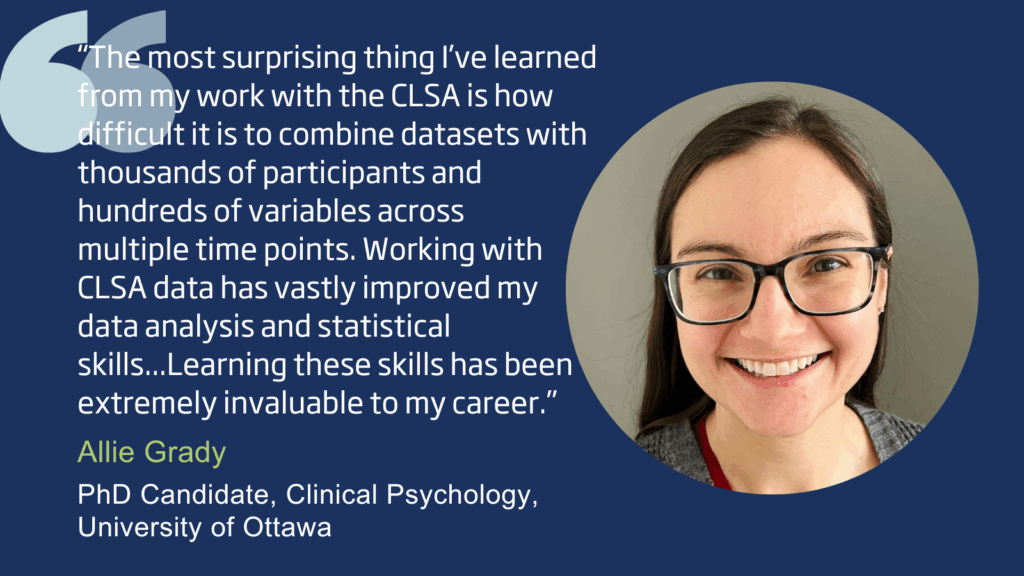
The most surprising thing I’ve learned from my work with the CLSA is how difficult it is to combine datasets with thousands of participants and hundreds of variables across multiple time points. Working with CLSA data has vastly improved my data analysis and statistical skills. It has helped me become more comfortable working with larger datasets (e.g., the Canadian Community Health Survey). Learning these skills has been extremely invaluable to my career.
How do you think the CLSA will help you grow as a student or in your future?
Because of my work with the CLSA, I am connected to a growing body of researchers and trainees who are interested in aging. I am always delighted to run into fellow CLSA researchers at conferences and events. I am also grateful to have a better grasp on longitudinal research, which helps me connect with researchers worldwide who are working with comparable projects (e.g., the English Longitudinal Study of Ageing, the Health and Retirement Study).
How do you think the findings using CLSA data will be useful to you, or others, in the future?
Our findings on mental health, cognition, and social support in LGB communities will be useful for researchers, policymakers, and LGB individuals. For researchers, our work with the CLSA fills important gaps in the experiences of older LGB Canadians, which can help inform and guide future research. For policymakers, this research highlights gaps in services for older LGB communities (e.g., mental health services), and this evidence can be used to advocate for increased funding in this area. For members of LGB communities, our work can help folks understand the risks and resources present within their communities, which may inform behavioural changes (e.g., working to build strong social support systems, quitting smoking) that will help them age well.
Do you have any idea about what kind of job you’d like to do when you finish school?
When I finish school, I hope to become a clinical geropsychologist —a psychologist who specializes in older adults. Ideally, I would like to continue conducting research, mentoring/teaching students, and seeing clients for assessment and therapy.
What is a non-career related thing that you are grateful for because of your work with the CLSA?
I am grateful for the ability to participate in the CLSA webinar series, which has allowed me the opportunity to share my work with my friends and family. They often ask me about my research, and now I have a recorded webinar to direct them to if they are interested in learning more.