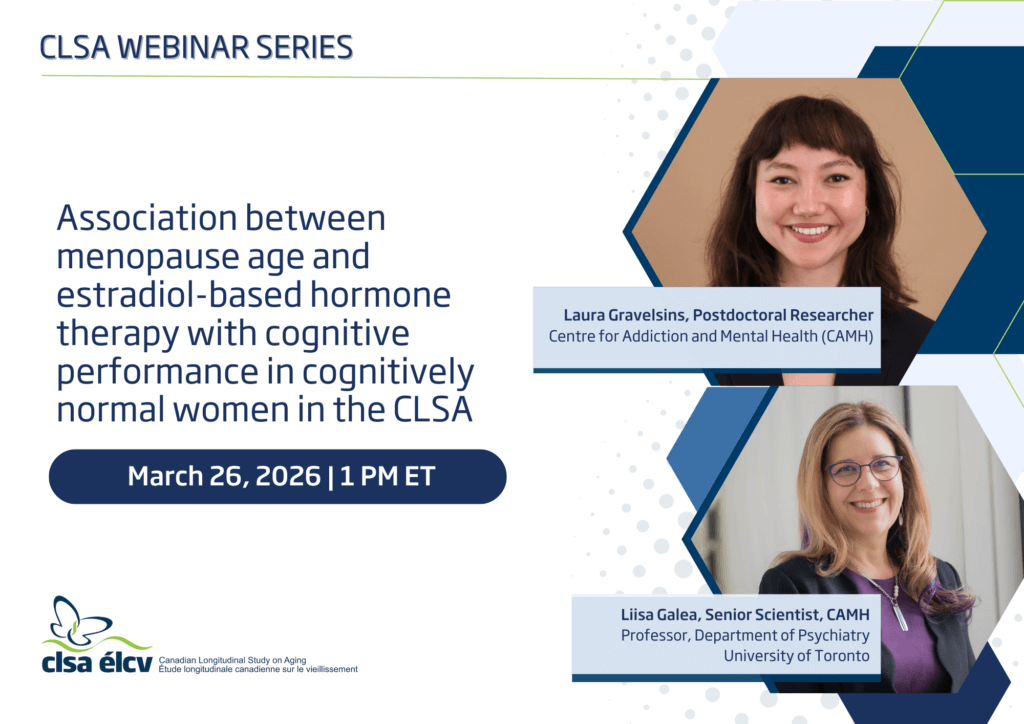
Join us Thursday, March 26 at 1 PM ET for the CLSA webinar “Association between menopause age and estradiol-based hormone therapy with cognitive performance in cognitively normal women in the CLSA.” The webinar will be presented by Dr. Liisa Galea, senior scientist at the Centre for Addiction and Mental Health (CAMH) and Professor in the Department of Psychiatry at the University of Toronto, and Dr. Laura Gravelsins, postdoctoral researcher at the Centre for Addiction and Mental Health.
Menopause and menopausal hormone therapy (MHT) can influence cognition in postmenopausal women, yet findings remain inconsistent. One limitation is insufficient consideration of female-specific factors that may contribute to heterogeneous effects, including age at menopause, route of administration of estradiol (E2)-based MHT formulation and reproductive history. Moreover, E2-based MHT may differentially affect distinct cognitive domains. Using baseline data from the CLSA, we examined associations between menopause age and E2-based MHT on performance across three cognitive domains: medial temporal lobe–based recall, prospective memory, and frontal lobe–based cognition.
Dr. Liisa Galea is the Treliving Family Chair in Women’s Mental Health at the Centre for Addiction and Mental Health and a Professor in the Department of Psychiatry at the University of Toronto. She leads the Women’s Health Research Cluster, a dedicated network to promote and catalyse impactful women’s health research with over1000 members across 43 countries. Dr. Galea is a world-renowned expert in sex and sex hormone influences on the brain, with a focus on stress-related psychiatric disorders and dementia. She has published over 220 scientific papers and is a Fellow of the Canadian Academy of Health Sciences and a Top 25 Women of Influence in Canada in 2025.
Dr. Laura Gravelsins is a researcher committed to advancing Sex- and Gender-Based Analysis Plus (SGBA+) and gender equity in neuroscience. She earned her PhD in Psychology from the University of Toronto in 2024 and is currently a postdoctoral fellow with Dr. Liisa Galea at the Centre for Addiction and Mental Health (CAMH). Her research focuses on how ovarian hormones influence memory, brain health, and quality of life across the lifespan. During her Master’s training, Dr. Gravelsins examined the effects of hormonal contraception on working memory in younger females. Her doctoral research investigated how hormone therapy influences cognition, brain structure, and sleep in middle-aged females with early ovarian removal—a population at elevated risk for later-life dementia. Building on this work, her current postdoctoral research in the Galea Lab uses mixed-methods approaches – integrating large-scale quantitative data with in-depth qualitative interviews – to better understand menopause-related influences on brain health in older females.