Tell us about yourself in a paragraph or two: What is your name, and what are you studying? Where are you from? What was your dream job as a kid? What’s your favourite thing to do outside of school/work?
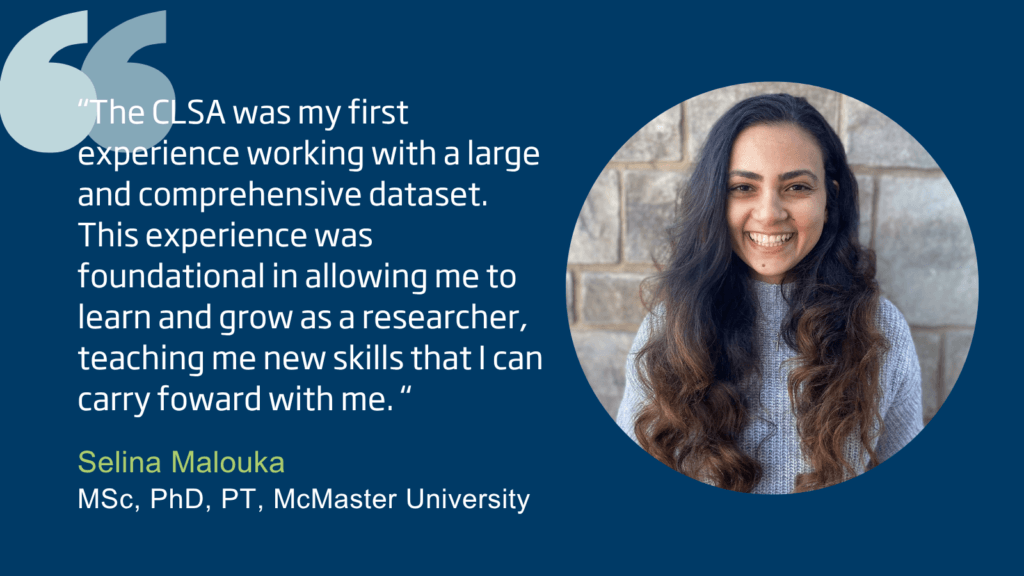
My name is Selina Malouka. I currently live in Toronto; however, I was born in Egypt and lived in Kuwait throughout my childhood. Recently, I completed my MSc in Physiotherapy and PhD from McMaster University and am currently practicing as a physiotherapist. My research is centered on mobility and aging, with a particular focus on evaluating the psychometric properties of a tool used to measure real-world mobility called the Life-Space Assessment. Prior to that, I completed my bachelor’s degree in kinesiology from the University of Toronto, with a minor in psychology.
Growing up, my dream was to become a scientist. Science was always my favourite subject in school, and I imagined myself one day creating all the latest gadgets. I would often spend hours designing new “inventions” out of aluminum foil and pipe cleaners, I also I wanted to become an astronaut but that dream soon died when I found out that I was afraid of heights. Outside of work, I love spending time outdoors, playing board games, and creating art pieces.
What interested you about the CLSA?
I was not familiar with the CLSA prior to beginning my PhD, but I was introduced to the study by my supervisor. As I learned more about the CLSA, I became excited by the opportunity to work with a large, nationally representative dataset and develop my skills in managing complex data and conducting advanced statistical analyses.
What type of research are you doing with CLSA data? Have you published? If so, what are the findings (in lay terms)?
My research focuses on assessing life-space mobility (i.e., community mobility) among Canadian adults. More specifically, it focuses on assessing the measurement properties (e.g., the validity) of a life-space mobility measure called the Life-Space Assessment (LSA).
Through our research, we generated reference values for the LSA scores, split by age and sex, and generated percentile graphs which illustrated the trends in scores at each percentile of the population. Overall trends showed that LSA scores were lower for females than males and that scores were lower in older age groups. Individuals scoring at the lower percentiles also demonstrated greater declines as age increased. This research was published in Aging Clinical and Experimental Research in 2023.
We are also currently preparing two manuscripts for publication investigating the construct and predictive validity of the LSA in this population. In terms of construct validity, the LSA had low correlations with other measures of mobility, suggesting that it measures a different construct than existing tools. The LSA also demonstrated limited predictive validity for the chosen outcomes (e.g., hospitalization and emergency department visits) after a 3-year follow-up, likely due to the sample being highly functioning at baseline.
What is the most interesting or surprising thing you’ve learned from your work with the CLSA? How do you think the CLSA will help you grow as a student or in your future?
The CLSA was my first experience working with a large and comprehensive dataset. I really enjoyed learning new statistical approaches and having access to a wide variety of variables to explore secondary research questions and adjust for in our analyses. This experience was foundational in allowing me to learn and grow as a researcher, teaching me new skills that I can carry forward with me such as data management, data analyses and interpretation, and experience using various statistical software.
How do you think the findings using CLSA data will be useful to you, or others, in the future?
The LSA has gained increasing attention in the literature as a valuable measure of real-world mobility. In our work, we generated reference values for the LSA within the CLSA, providing a useful benchmark for researchers and clinicians to interpret and contextualize LSA scores. We also examined the construct and predictive validity of the LSA in this population, which contributes to the body of evidence required prior to making a decision about using this outcome measure in a community-dwelling Canadian population.
Do you have any idea about what kind of job you’d like to do when you finish school?
I am currently seeking opportunities to pursue postdoctoral studies. Having completed my MSc in Physiotherapy and PhD in Rehabilitation Science, my goal is to build a career that integrates both my clinical and research interests as a clinician-scientist. I am excited to be able to bring a clinical perspective to my research while translating research findings to clinical practice.
What is a non-career related thing that you are grateful for because of your work with the CLSA?
I began my PhD studies during the COVID-19 pandemic —a time where primary data collection was uncertain. I was fortunate to have the opportunity to work with a secondary dataset which allowed me to pursue meaningful research despite the challenges of that time.