Tell us about yourself in a paragraph or two: What is your name, and what are you studying? Where are you from? What was your dream job as a kid? What’s your favourite thing to do outside of school/work?
My name is Hannah-Ruth Engelbrecht, and I am currently pursuing my PhD at UBC. My PhD is all about “biological age” in different forms – I investigate epigenetic and biophysiological indicators of healthy aging, their congruency, and what they can tell us about aging well in different global populations. I am from South Africa and moved to Canada for my PhD. As a child, I was desperate to be a big game vet! I developed an interest somewhere along the way in genetics and physiology, which led to a BSc and MSc in human genetics – not quite big game, but still interesting nonetheless! I have always wanted to do something that makes the world a better place – for now that’s research.
Outside of work, I enjoy reading and writing – I’m a terrible poet, but I turn a decent short story. I dance, spend time with my dogs, and, on the rare occasion, bake! I love being outside, and BC is a wonderful place to be for that.
What interested you about the CLSA?
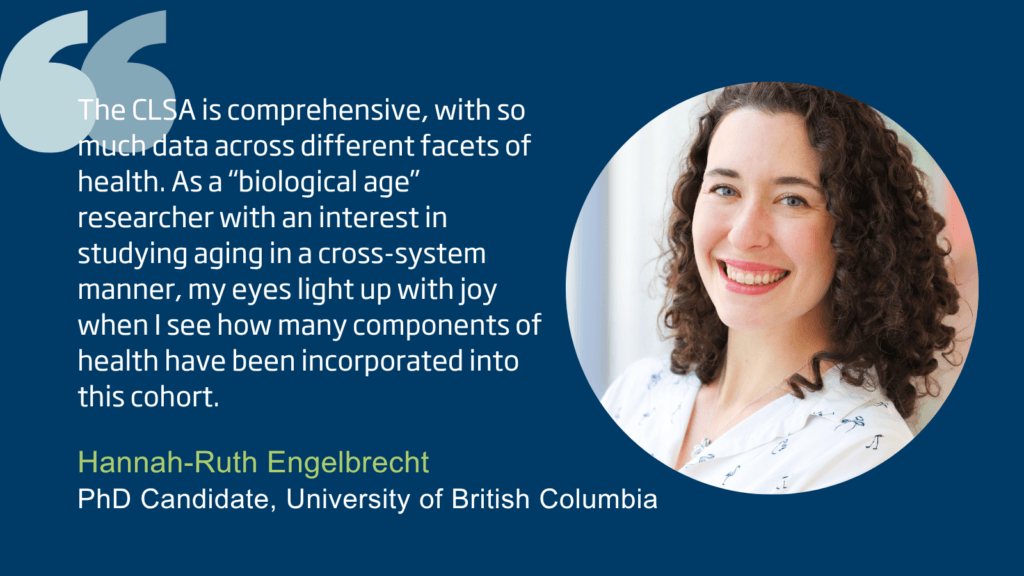
The CLSA is comprehensive, with so much data across different facets of health. As a “biological age” researcher with an interest in studying aging in a cross-system manner, my eyes light up with joy when I see how many components of health have been incorporated into this cohort.
What type of research are you doing with CLSA data? Have you published? If so, what are the findings (in lay terms)?
My research with the CLSA is not yet published, but hopefully early in the new year we’ll see some things happening on that front! My CLSA project focuses on how epigenetic age predictors or inflammatory biomarkers associate with more physiological and functional healthy aging measures, and there is less congruency than some might think.
What is the most interesting or surprising thing you’ve learned from your work with the CLSA? How do you think the CLSA will help you grow as a student or in your future?
I think working with the CLSA has reminded me that just because someone might not “look” healthy according to some measures, they might be doing very well, and as researchers we need to be aware that when we are assessing health, we should consider a person’s holistic self, not just a set of molecular markers. Given the comprehensiveness of the dataset, my data cleaning and data wrangling skills also received some polish.
Looking forward, being aware of additional resources and the continued richness of this dataset, I keep thinking of new questions! I think a cohort like the CLSA continues to inspire especially when you meet others using the same cohort for completely different research.
How do you think the findings using CLSA data will be useful to you, or others, in the future?
A cohort like the CLSA benefits health researchers in Canada, who can draw conclusions from a more local and relevant cohort than from cohorts in other countries (which are also useful!) with different societal structures. Hopefully a resource like the CLSA as it goes forward will translate into relevant health research information for Canadians and the Canadian health system more broadly.
Do you have any idea about what kind of job you’d like to do when you finish school?
I’m open to many things, but I think any role where I can use my data analytics skills as well as pursue interesting questions would make me happy. Hopefully I will get more involved in research translation, too.
What is a non-career related thing that you are grateful for because of your work with the CLSA?
I have met so many lovely people as a result of my work with the CLSA, including a participant from the CLSA after a public lecture! It’s rewarding to see researchers tackling a project like this from conception to reality, knowing that there are people who are invested in the long-term wellbeing of Canadians and aging people in general.